


Put بَ, بِ and بُ in front of a five-year-old and ask which one says “bu”. You’ll probably get a guess. The letter is the same in all three, and the only difference is a little stroke on top, a little stroke underneath, or a tiny curl. For a child who is still getting to know the letter itself, those marks barely register. Most of the work in teaching Arabic harakat for kids is making those small marks feel big.
This is the order we’ve seen work at home, even where the grown-up doesn’t read Arabic.
Arabic harakat for kids: one mark at a time, not three
The common mistake is teaching fatha, kasra and damma in the same week because they look like a set. To an adult they are. To a child they’re three nearly identical squiggles.
Give fatha a stretch of time on its own. It’s the slanted line above the letter, and it says a short “a”, as in cat. Once your child can read single letters with fatha (ba, ta, tha), move on to words where every letter has one: كَتَبَ (kataba, he wrote), فَتَحَ (fataḥa, he opened), جَلَسَ (jalasa, he sat). Three letters, three identical vowels. It sounds almost too easy. Good. Your child is reading real words that mean something.
Kasra comes next: the same slanted line, but underneath, saying “i” as in sit. This is where the mix-ups start, and one question helps more than any explanation: is the line on the roof or in the basement? Then damma, the small curl that looks like a tiny waw, saying “u” as in put. Only after all three have had their own time do you mix them on one page.
| Mark | Sound | Word | Say it | Meaning |
|---|---|---|---|---|
| Fatha | a | كَتَبَ | kataba | he wrote |
| Kasra | i | شَرِبَ | shariba | he drank |
| Damma | u | كُتِبَ | kutiba | it was written |
| Sukun | no vowel | يَكْتُبُ | yaktubu | he writes |
| Long alif | aa | نَامَ | nāma | he slept |
| Long waw | uu | يَقُولُ | yaqūlu | he says |
| Long ya | ii | يَطِيرُ | yaṭīru | it flies |
A colour and a body move for each mark
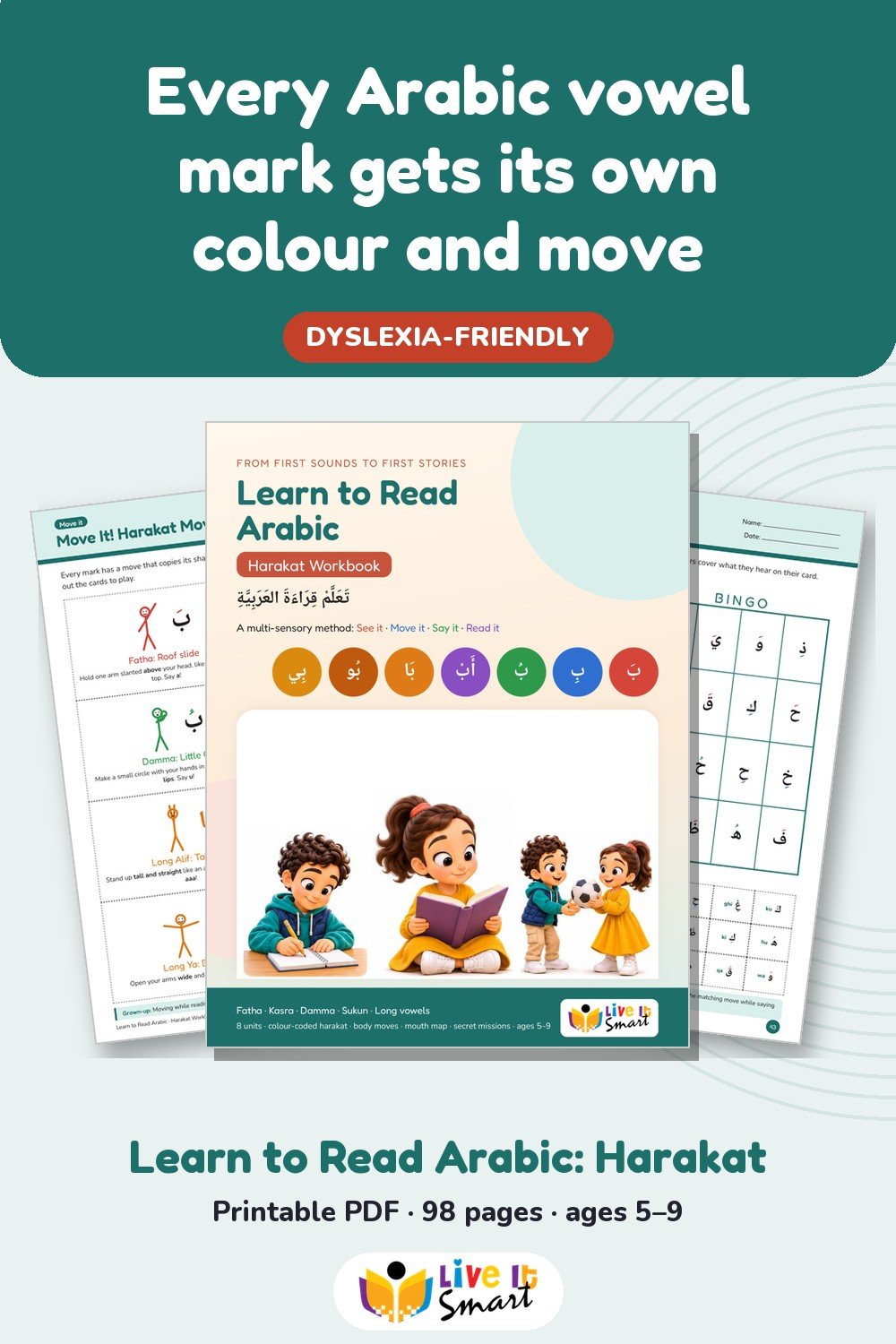
Children who find reading hard often do better when a sound has somewhere to live outside the page, so each mark gets a colour and a movement that copies its shape. For fatha, one arm goes up at a slant above your head: the roof slide. Kasra is the same arm slanted down by your waist. Damma is a small circle made with your hands in front of round lips. Sukun is a flat hand held up like a stop sign, and everybody freezes.
The long vowels get bigger moves: stand tall like an alif for “aaa”, a big circle over your head for “uuu”, arms wide and a big smile for “iii”. It looks silly. It is silly, and a child who can’t sit still for a worksheet will happily do it twenty times while you call out sounds.

Those are the move cards and the Mouth Map from our workbook, though index cards and a marker would do the job too. One thing we’d add from experience: let the colours fade. If every page stays colour-coded forever, some children quietly learn to read the colours instead of the marks, and a plain black page leaves them stranded. In the workbook, the last stories are in plain black.
The throat sounds English doesn’t have
The Mouth Map groups the letters by where the sound is made, from the lips at the front to the throat at the back. Try it at the bathroom mirror: lips, tongue or throat?
Pairs help most. كَالَ and قَالَ differ only in the first letter, a light k and then a deep k from much further back. سَارَ and صَارَ are a light s and a heavy s. Say one and let your child point to it. These sounds can take months to settle, even for children who read well. That’s normal.
Sukun, then the long vowels
Sukun is the small circle above a letter, and it means there’s no vowel there at all. Your child reads the letter before it and closes the sound onto it, so أَبْ is “ab”. This is where reading starts to sound like reading, because words like يَكْتُبُ (yaktubu, he writes) become possible, and with a name added you’ve got a sentence: تَقْرَأُ مَرْيَمُ. Maryam reads.
Then the long vowels. A fatha followed by an alif makes a long “aa”, so نَامَ is nāma, he slept. A damma before a waw gives “uu”, and a kasra before a ya gives “ii”. The long letter carries no mark of its own, which throws some children at first. Cover it with a finger, read the short sound, then lift the finger and stretch it.
Ten minutes at the kitchen table
One page a day, ten to fifteen minutes, is plenty. Stop while your child still wants to do one more. If they’re yawning by minute six, stop at six.
Watch out for picture-guessing. A child who sees a drawing of a boy with a cup will say “shariba” with total confidence and never look at the letters. Cover the picture, let them read, then uncover it as the reward. Same with the transliteration: it’s there for you, so keep a hand over it while your child reads.
Variety keeps it going. In a secret mission, your child reads each Arabic sound, finds it in a code key and writes down the English letter until a message appears. Children who groan at “read this row” will decode a whole page to find out it says YOU ARE A STAR.

That’s a secret mission page and one of the comic breaks, which use only the marks learned so far. When a comic is done, ask your child to read it to someone who wasn’t there for the lesson; a grandparent on a video call works well.
If the letters themselves are still wobbly, go back a step with our free Arabic alphabet worksheets first.
Our 98-page Harakat Workbook
If you’d rather not build all this yourself, the Learn to Read Arabic Harakat Workbook in our shop is the printable version. It’s 98 pages in eight units, from fatha to long ya, each with tracing, word building, a game, a secret mission and a checkpoint. The move cards, the Mouth Map, three comic breaks and two picture stories are included. A short grown-up note on every activity page means you don’t need to read Arabic to run the lesson. It’s written for ages 5 to 9 and older beginners, in US Letter and A4.
We call it dyslexia-friendly because of how it’s put together: one new mark at a time, a colour and a movement for each, short tasks and clean pages. It’s practice material, not a diagnosis or a treatment. It’s also the first book in the Starter bundle, with Learn to Read Arabic 2 and Bye-Bye Harakat. Later on, our 200 common Arabic words give you more to read together.
One last practical thing: put a small pencil tick in the corner of every page your child reads without help. After a few weeks, flip back through the book together and count the ticks. Children rarely believe how far they’ve come until they can see it.
Free: the Harakat Starter Pack
15 printable pages: the whole fatha unit, the Harakat Moves cards and the Mouth Map. Enter your email and it’s yours.
Want to come back to this later? Save it to your Pinterest board.


No Comments