


Pick up an Arabic newspaper, a shop sign or the back of a juice carton and you’ll find hardly any vowel marks. For a child who has spent a year learning fatha, kasra and damma, that comes as a nasty surprise. Reading Arabic without harakat is a separate skill from reading with them, and it goes much better when you teach it on purpose instead of hoping it shows up by itself.
Why grown-up Arabic leaves the marks out
Adult readers know the words. When they see كتاب they don’t need to be told it’s kitābun; they recognise the shape the way you recognise “yacht” without sounding it out. And when one set of letters could be two different words, the rest of the sentence settles it. That’s all the marks were ever doing for a beginner, telling them sounds they didn’t know yet.
Children’s books and the mushaf keep the marks. Nearly everything else drops them. So a child who can only read fully vowelled text will hit a wall the first time they try to read a poster at the mosque or a label at the shop.
Reading Arabic without harakat, one kind of mark at a time
The worst way to do this is to jump from full marks to none. Your child loses every support at once and starts guessing, and guessing quickly turns into “I can’t read this”. A gentler route takes away one kind of mark at a time, on words your child already knows, in an order where each step makes sense.
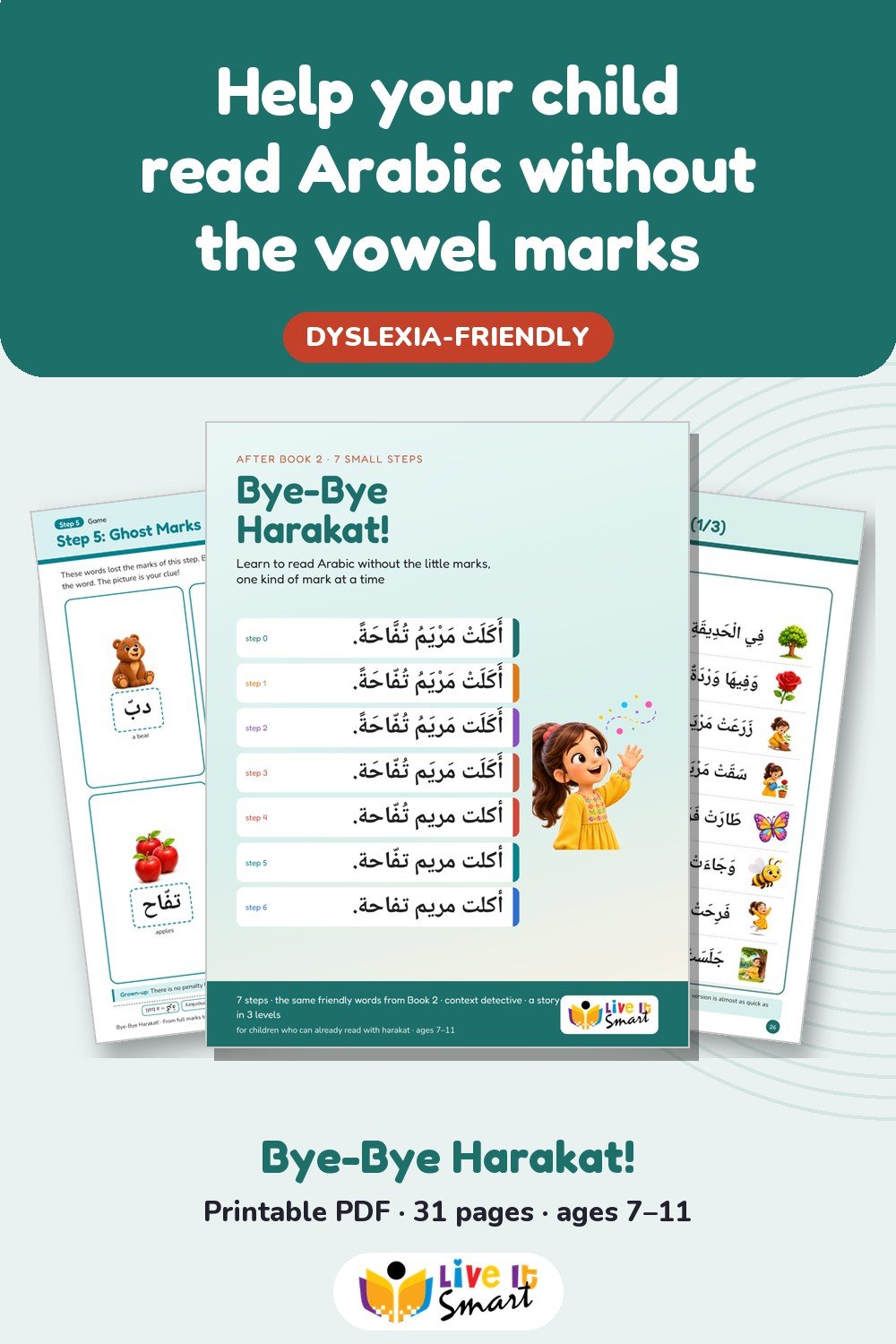
The sentence below is Maryam ate an apple, and you can watch it lose its marks over seven steps.
| Step | What goes | The sentence |
|---|---|---|
| 0 | Nothing yet | أَكَلَتْ مَرْيَمُ تُفَّاحَةً. |
| 1 | The mark before a long letter | أَكَلَتْ مَرْيَمُ تُفّاحَةً. |
| 2 | Every sukun | أَكَلَت مَريَمُ تُفّاحَةً. |
| 3 | The last mark of each word | أَكَلَت مَريَم تُفّاحَة. |
| 4 | Every fatha | أكلت مريم تُفّاحة. |
| 5 | Kasra, damma and tanween | أكلت مريم تفّاحة. |
| 6 | Everything, even the shadda | أكلت مريم تفاحة. |
Each step has a reason a child can understand. A long alif always comes after a fatha, so the fatha in front of it isn’t telling you anything new. A letter with no mark is simply said with no vowel, and your mouth already knows how. You don’t say the last vowel when you pause after a word, so you don’t need to see it either. Fatha is the most common mark of all, which means a bare letter is worth trying with “a” first. The shadda hangs on longest, as the last helper, because it tells you a letter is said twice.

Those are the first two rule pages. Each one shows a word with the marks, an arrow, and the same word after that step, with a small picture beside it. Read the marked version first and ask your child which marks went away. Most children enjoy being the one who spots it.
How long to stay on each step
Move on when the words of a step come out smoothly. Smoothly, not flawlessly. For some children a step takes a day; for others it’s a week, or two. That’s fine.
When a word trips them up, go back one step. The same kind of word is there with one more kind of mark, and seeing it again usually sorts the problem out in seconds. Going backwards isn’t failing. It’s how the skill gets built.
Pictures need a word of warning. Earlier on, a child who guesses from the picture is skipping the reading, so you cover it. At this stage, the picture is allowed to become a check. Read first, then look at the picture to see if you were right. We’ve sat at plenty of kitchen tables where a child read “cat” correctly and then glanced at the picture with a look of pure relief. That’s the habit you want: read, then check.
When the same letters spell two words
This is where children start reading the way adults do. Without marks, الحب could be الْحَبَّ (al-ḥabba, the grain) or الْحُبُّ (al-ḥubbu, love). Only the sentence can tell you which. In أَكَلَ الدِّيكُ الْحَبَّ. the rooster ate the grain, and nobody eats love. In الْحُبُّ جَمِيلٌ. love is beautiful. It’s the same with كتب, which might be كَتَبَ (he wrote) or كُتُبٌ (books).
Turn it into a detective game. Write the bare word in a box inside its sentence, and your child pencils the marks back in. There’s no penalty for a wrong mark, because the aim is to think about the sound, and checking against an answer key together is half the fun.
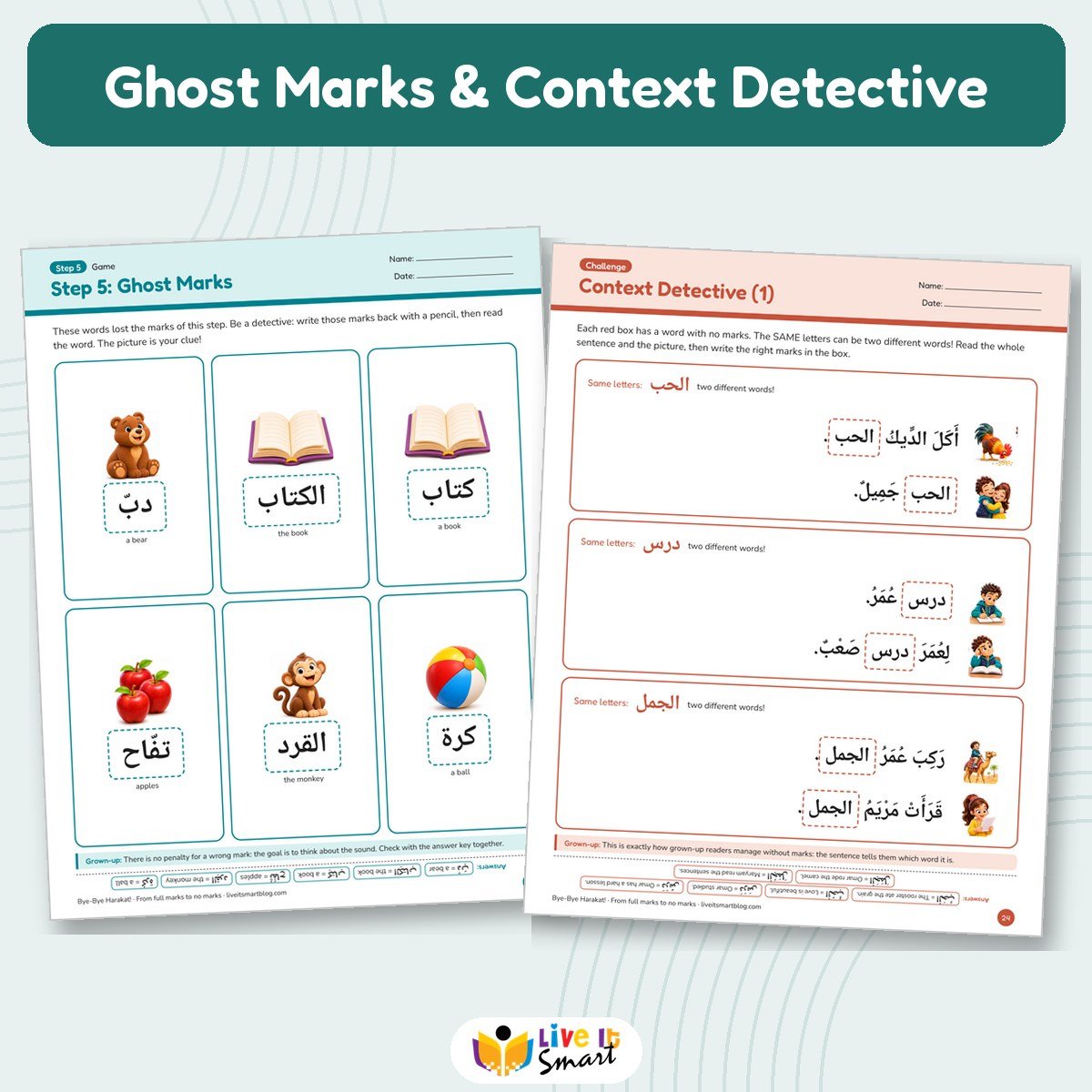
On the left is a Ghost Marks game, where words like a bear, a book and some apples have lost their marks and your child writes them back. On the right is the first Context Detective page.
One story, read three times
This next bit is what finally convinces most children they can do it. Take a short story they already know and have them read it three times: once with every mark, once with about half the marks gone, and once with none. The first line of “Maryam’s Garden” looks like this at each level.
| Version | First line |
|---|---|
| All the marks | فِي الْحَدِيقَةِ شَجَرَةٌ. |
| Half the marks | في الحَديقَة شَجَرَة. |
| No marks | في الحديقة شجرة. |
It means “In the garden there is a tree.” If your child likes a challenge, time each reading on your phone. Most are surprised that the bare version is nearly as quick as the first. Some children hate a stopwatch, though. Skip it for them.
Bye-Bye Harakat!, a 31-page step-by-step book
We put this whole approach into Bye-Bye Harakat! in our shop. It’s 31 pages: a start page called Where Did the Marks Go?, then seven steps of three pages each (the rule with before-and-after words, a Read It page with ten pictured words and two sentences, and a game). After that come two Context Detective pages, “Maryam’s Garden” at three levels, a certificate and an answer key, with answers printed upside down at the bottom of each game page.
It’s meant for ages 7 to 11, for children who already read fully vowelled Arabic, and nearly all the words come from Learn to Read Arabic 2, so they’re old friends. We call it dyslexia-friendly because the marks go one kind at a time, the words are familiar, and every word has a picture to check against. It’s practice material, not a diagnosis or treatment. It prints in US Letter and A4, and it’s the last book in our Starter bundle, after the Harakat Workbook and Book 2.
If you need more familiar words to practise on first, our 200 common Arabic words and the free Arabic worksheets are a good place to collect them.
One practical habit to finish: when your child reaches Step 6, stick the Read It page on the fridge and leave it there for a week. Ask for one word from it each time they pass on the way to the snacks. Thirty seconds, no table, no pencil.
Free: the Harakat Starter Pack
15 printable pages: the whole fatha unit, the Harakat Moves cards and the Mouth Map. Enter your email and it’s yours.
Want to come back to this later? Save it to your Pinterest board.


No Comments