


He chats with his grandmother on video every Friday. He understands every joke his uncles make. Put a page of Arabic in front of him, though, and he goes quiet. A lot of Arab families raising children in English-medium schools, in the Gulf or abroad, end up here: their child speaks Arabic but can’t read it, and they aren’t sure whether to worry.
Mostly, you shouldn’t. This is very fixable, because the hardest part (knowing the words) is already done. What’s missing is the link between sounds the child already owns and the marks on the page.
Ready to turn speaking into reading?
Our free Harakat Starter Pack gives you 15 printable pages to begin: the whole fatha unit, the Harakat Moves cards and the Mouth Map. Enter your email and it’s yours.
Why a child speaks Arabic but can’t read it
Reading is a separate skill from speaking, in every language. Your child picked up spoken Arabic from you, the way all children pick up speech. Reading had to be taught, and if the school teaches mostly in English, with Arabic lessons a few times a week, the English reading got far more practice.
There’s a second layer. The Arabic your family speaks at home is probably a dialect, and the Arabic in books is the standard written form. They share most of their words, but not all, and some sounds and endings differ. A child reading الْقِطَّةُ جَائِعَةٌ. (the cat is hungry) may know exactly what it means and still stumble on the endings, because nobody at home says them like that.
None of this means something is wrong with your child. It means the reading side needs its own time.
Start from words they already say
This is your big advantage over families learning Arabic from zero. Take words your child uses every day and show them in writing: بَيْتٌ (house), شَمْسٌ (the sun), قَمَرٌ (the moon). When a child reads a word and recognises it as something they say, reading suddenly makes sense. It stops being a school exercise.
Use family names too. Write your child’s name, a sibling’s, Teta’s. Children will work hard to read a word that belongs to someone they love.
Keep the vowel marks on for now, even if your child is older. Adults read without them because they already know the words, but a new reader needs the marks to turn letters into sounds. They can come off gradually once reading is fluent.

Check the letters before anything else
Some children who “can’t read Arabic” actually know most of the letters but not all of them, and those few gaps make every page feel impossible. Spend one session finding out. Point at letters in random order and ask for the sound, not the name. Make a quiet pile of the ones they miss.
The usual suspects are the look-alike letters (same shape, different dots) and the sounds English doesn’t have. Spoken Arabic helps a lot with the second group, since your child already says them correctly. The job is connecting the sound to the shape.
Then practise only the pile, a few letters a day. Our free alphabet tracing sheets are handy here: print only the pages for the missing letters.
Short vowels, one at a time
Once the letters are steady, reading depends on the three short vowel marks. Children who speak Arabic usually hear the difference instantly. What they need is to see it.
| Word | Say it | Meaning |
|---|---|---|
| كَتَبَ | kataba | he wrote |
| يَكْتُبُ | yaktubu | he writes |
| كَاتِبْ | kātib | a writer |
| مَكْتَبْ | maktab | a desk, an office |
A word family like that suits a child who speaks Arabic well. They know all four words. They can see the same three letters inside each one. Ask them to find the k-t-b in every word, then read them aloud. For a step-by-step order, our guide to Arabic harakat for kids takes the marks one at a time.
Make reading Arabic part of normal family life
The biggest difference between your child’s English and Arabic reading is probably volume. They read English all day at school. Arabic gets a few lessons a week.
You can close some of that gap without making Arabic feel like extra homework. Leave notes in Arabic in the lunchbox. Write the shopping list in Arabic and let them read it out at the shop. Ask them to read a short message from a relative before you reply. Five or ten minutes a day is enough, as long as it’s most days.
Talk about it lightly. Children who feel embarrassed that they “should” read Arabic, because their cousins do, can avoid it altogether. Saying “you speak it so well, reading is the next bit” takes the shame out of it.
A structured option if you want one
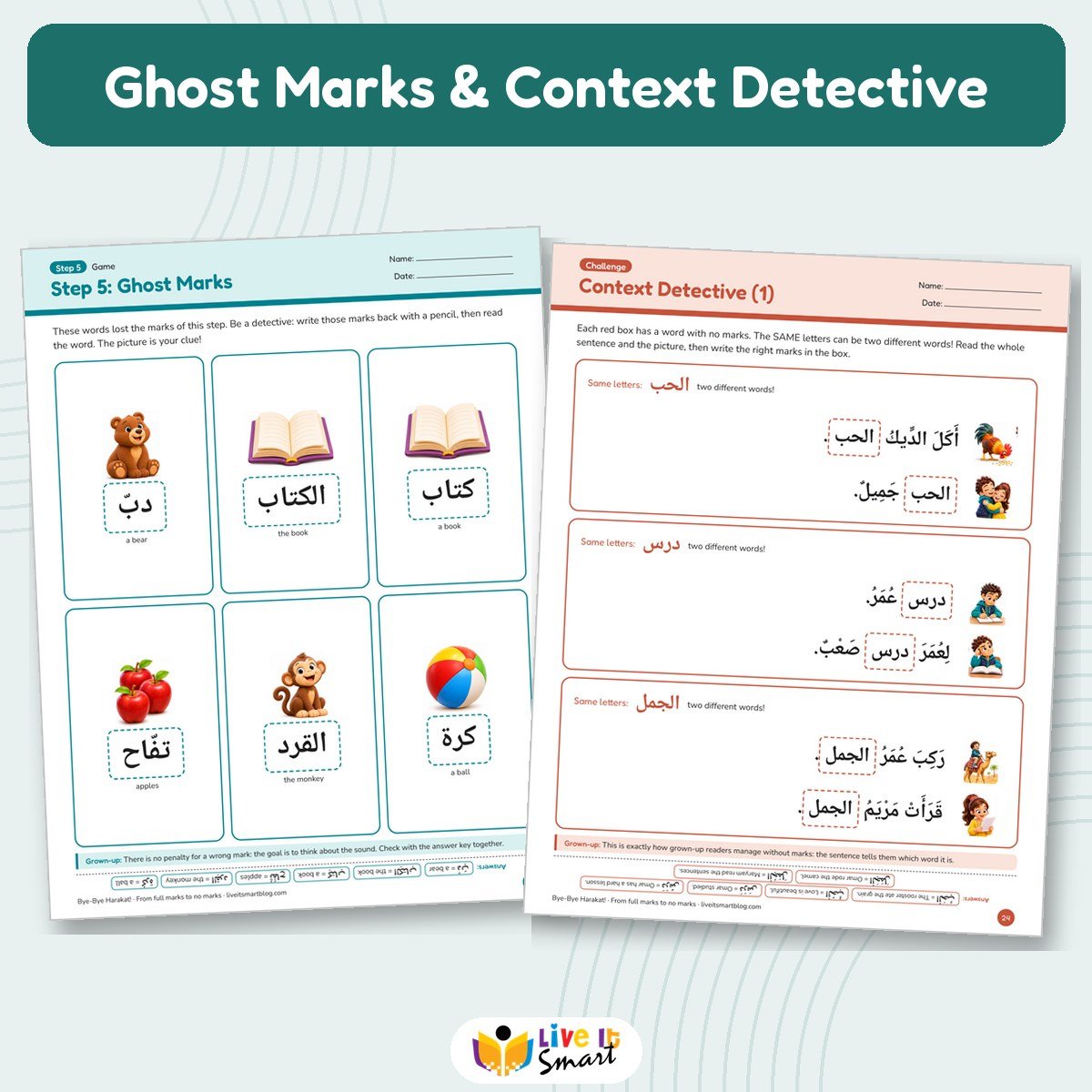
Some parents prefer a clear sequence to follow rather than making it up as they go. Our Learn to Read Arabic Starter Bundle on TPT is three printable workbooks that go from the short vowels and sukun, through tanween, shadda and the sun and moon letters, to reading without vowel marks at all. Every page teaches one thing, with colours and small movements for each mark, which makes it dyslexia-friendly and easy to use at the kitchen table. US Letter and A4 are both included. It’s home practice, meant to sit beside school, not instead of it.
A child who already speaks Arabic is closer to reading it than they look. Most of what’s left is time with the page, and someone next to them who knows the words too.


No Comments