


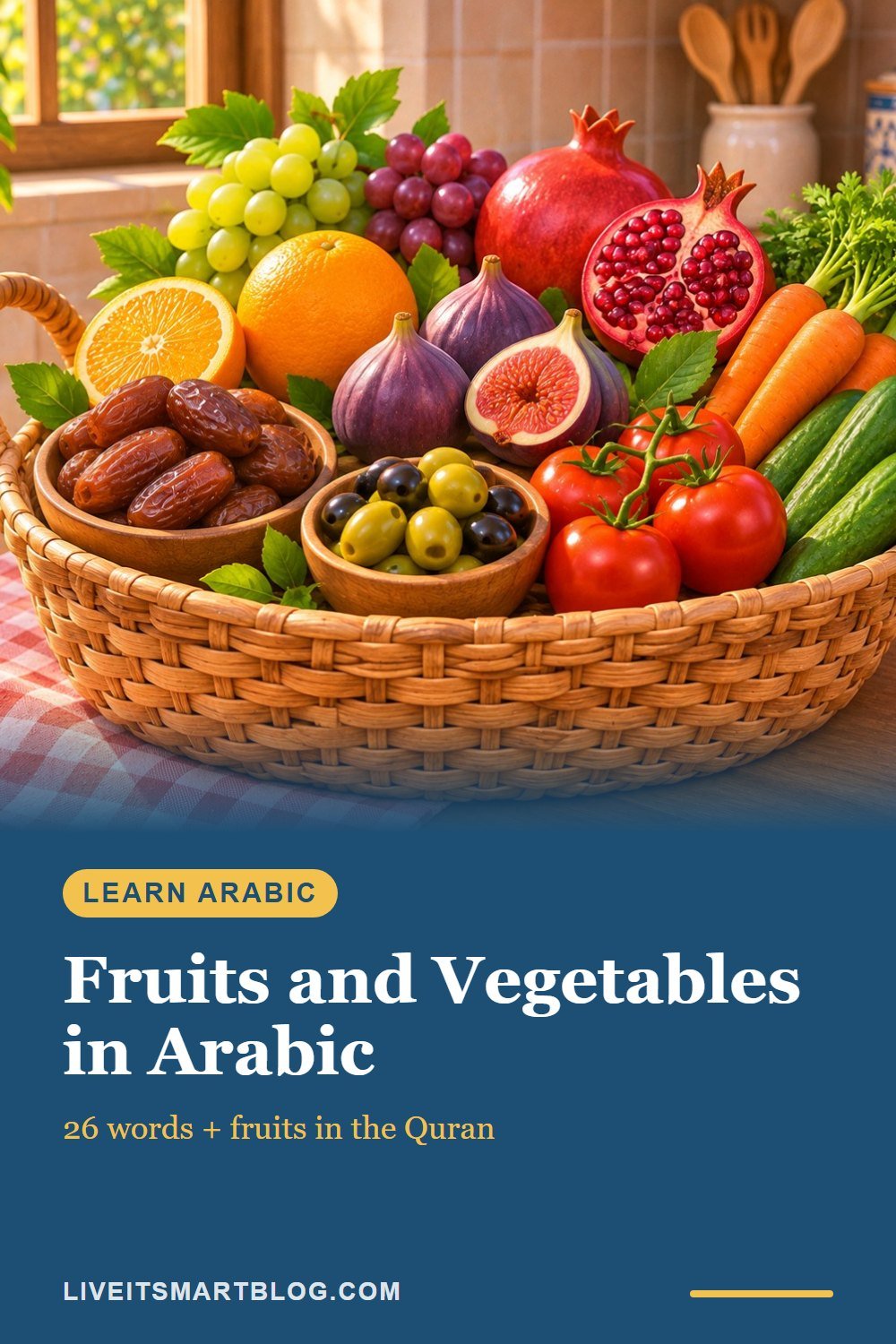
Most families teach Arabic food words without meaning to. “Pass the khubz.” “Who wants tamr?” This list takes that a step further, with 14 fruits and 12 vegetables you’ll actually find in a Western supermarket, and the fruits the Quran mentions by name.
Read the pronunciation column out loud: capital letters mark the stress, double vowels are held a beat longer, and the apostrophe stands for the throaty Arabic letter Ain (ع).
Fruits in Arabic
| English | Arabic | Say it |
|---|---|---|
| Apple | تُفَّاحَة | tuf-FAA-ha |
| Banana | مَوْزَة | MAW-za |
| Orange | بُرْتُقَالَة | bur-tu-QAA-la |
| Grapes | عِنَب | ‘I-nab |
| Dates | تَمْر | TAMR |
| Figs | تِين | TEEN |
| Olives | زَيْتُون | zay-TOON |
| Pomegranate | رُمَّانَة | rum-MAA-na |
| Watermelon | بِطِّيخَة | bit-TEE-kha |
| Strawberry | فَرَاوْلَة | fa-RAAW-la |
| Mango | مَانْجُو | MAAN-joo |
| Lemon | لَيْمُونَة | lay-MOO-na |
| Peach | خَوْخَة | KHAW-kha |
| Pear | كُمَّثْرَى | kum-MATH-raa |
Many fruit words end in -a (ة) when you mean one piece: tuffaha is one apple, tuffah is apples in general. Mawza is one banana, mawz is bananas.
Vegetables in Arabic
| English | Arabic | Say it |
|---|---|---|
| Tomato | طَمَاطِم | ta-MAA-tim |
| Cucumber | خِيَار | khi-YAAR |
| Carrot | جَزَر | JA-zar |
| Potato | بَطَاطِس | ba-TAA-tis |
| Onion | بَصَل | BA-sal |
| Garlic | ثُوم | THOOM |
| Lettuce | خَسّ | KHASS |
| Pepper | فُلْفُل | FUL-ful |
| Aubergine | بَاذِنْجَان | baa-dhin-JAAN |
| Courgette | كُوسَة | KOO-sa |
| Peas | بَازِلَّاء | baa-zil-LAA’ |
| Lentils | عَدَس | ‘A-das |
Fruits mentioned in the Quran
The Quran mentions several fruits by name, often as signs of Allah’s generosity. Dates, grapes, olives and pomegranates come up again and again:
“And it is He who sends down rain from the sky, and We produce thereby the growth of all things. We produce from it greenery from which We produce grains arranged in layers. And from the palm trees – of its emerging fruit are clusters hanging low. And [We produce] gardens of grapevines and olives and pomegranates, similar yet varied. Look at [each of] its fruit when it yields and [at] its ripening. Indeed in that are signs for a people who believe.”
Quran, Al-An’am 6:99 (Saheeh International)
“In both of them are fruit and palm trees and pomegranates.”
Quran, Ar-Rahman 55:68 (Saheeh International)
A whole surah opens with an oath by two fruits:
“By the fig and the olive”
Quran, At-Tin 95:1 (Saheeh International)
And Surat Abasa asks us to look at our food and think about where it came from:
“Then let mankind look at his food – How We poured down water in torrents, Then We broke open the earth, splitting [it with sprouts], And caused to grow within it grain And grapes and herbage And olive and palm trees And gardens of dense shrubbery And fruit and grass – [As] enjoyment [i.e., provision] for you and your grazing livestock.”
Quran, Abasa 80:24-32 (Saheeh International)
Practising in the kitchen
The supermarket beats any worksheet. Give your child a short shopping list with three Arabic words on it (draw pictures next to them for younger ones) and let them find the items. They’ll remember rummana far longer after hunting for a pomegranate between the mangoes.
At home, a cloth bag with one fruit hidden inside makes a quick guessing game: feel it, guess it, say it in Arabic. Once colours are learned, you can stack the words: mawza safraa’, a yellow banana; tuffaha hamraa’, a red apple. Our page on colours in Arabic has the rest.
The simplest habit of all is to name the food in Arabic when you say Bismillah at the table.
For more everyday vocabulary, see 50 first Arabic words for kids, and our free Arabic alphabet worksheets to learn the letters.
Want to come back to this later? Save it to your Pinterest board.


No Comments