


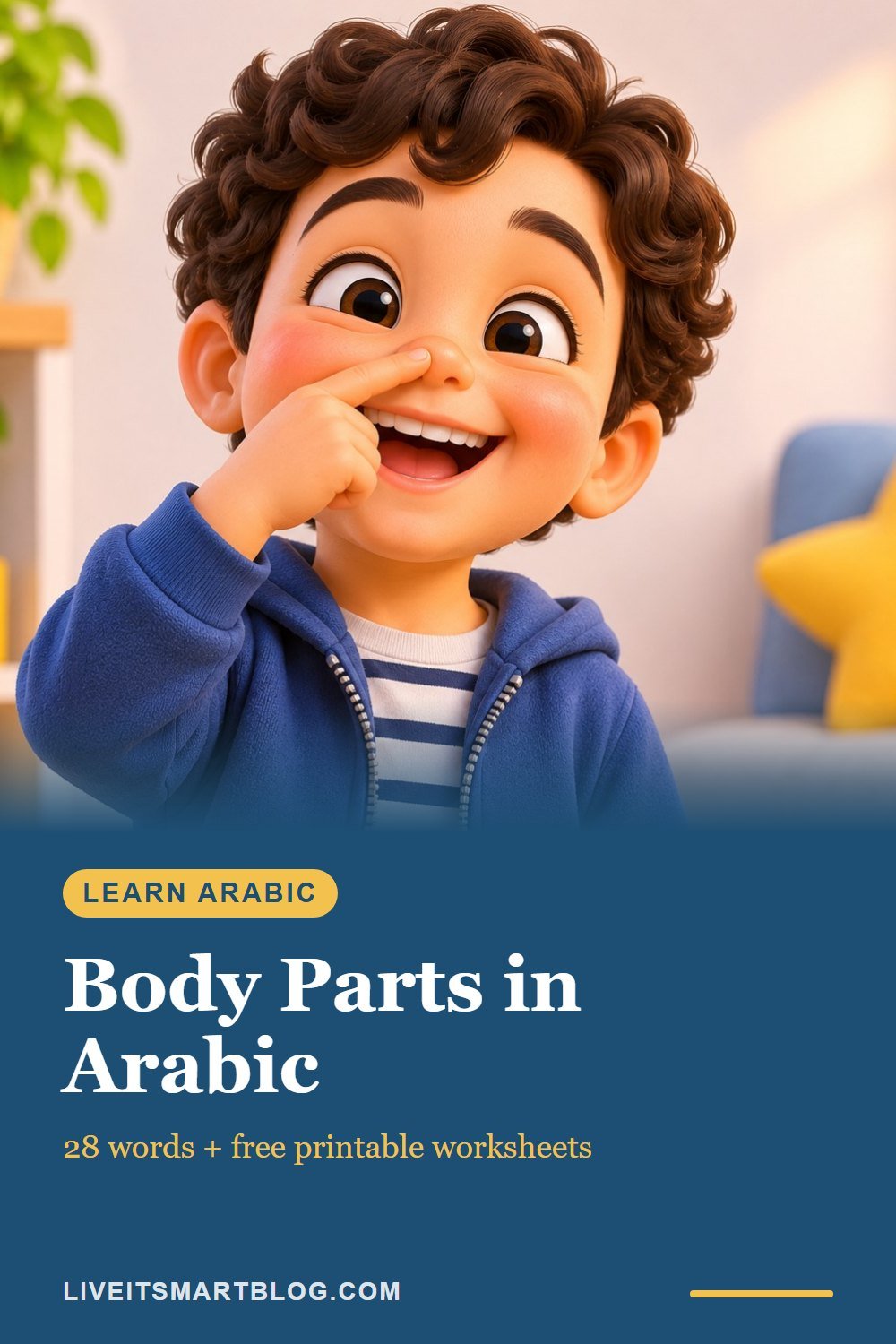
Ask a three-year-old to touch their nose and they’ll do it before you finish the sentence. That’s why body parts are usually the first Arabic topic teachers reach for: the words come with built-in actions. This page has 28 of them, split into the head and the rest of the body, plus a neat bit of Arabic grammar for things that come in pairs.
In the pronunciation column, capitals show the stressed syllable and the apostrophe is the Arabic letter Ain (ع), said from deep in the throat.
Body parts in Arabic: the head and face
| English | Arabic | Say it |
|---|---|---|
| Head | رَأْس | RA’S |
| Hair | شَعْر | SHA’R |
| Face | وَجْه | WAJH |
| Forehead | جَبْهَة | JAB-ha |
| Eye | عَيْن | ‘AYN |
| Ear | أُذُن | U-dhun |
| Nose | أَنْف | ANF |
| Mouth | فَم | FAM |
| Lip | شَفَة | SHA-fa |
| Tooth | سِنّ | SINN |
| Tongue | لِسَان | li-SAAN |
| Cheek | خَدّ | KHADD |
| Chin | ذَقْن | DHAQN |
| Neck | رَقَبَة | RA-qa-ba |
The rest of the body in Arabic
| English | Arabic | Say it |
|---|---|---|
| Shoulder | كَتِف | KA-tif |
| Arm | ذِرَاع | dhi-RAA’ |
| Elbow | مِرْفَق | MIR-faq |
| Hand | يَد | YAD |
| Finger | إِصْبَع | IS-ba’ |
| Nail | ظُفْر | ZUFR |
| Chest | صَدْر | SADR |
| Stomach | بَطْن | BATN |
| Back | ظَهْر | ZAHR |
| Leg | رِجْل | RIJL |
| Knee | رُكْبَة | RUK-ba |
| Foot | قَدَم | QA-dam |
| Heart | قَلْب | QALB |
| Bones | عِظَام | ‘i-ZAAM |
Saying “two eyes” and “two hands”
Arabic has a special form for exactly two of something, which is handy for body parts that come in pairs. Add -aan to the end:
| English | Arabic | Say it |
|---|---|---|
| Two eyes | عَيْنَانِ | ‘ay-NAAN |
| Two ears | أُذُنَانِ | u-dhu-NAAN |
| Two hands | يَدَانِ | ya-DAAN |
| Two feet | قَدَمَانِ | qa-da-MAAN |
Free body parts worksheets
Each of these free printable sheets has a picture, the word in English and Arabic, and dotted lines to trace both:
The body in the Quran
The Quran reminds us that our eyes, tongue and lips are gifts:
“Have We not made for him two eyes? And a tongue and two lips?”
Quran, Al-Balad 90:8-9 (Saheeh International)
“And Allāh has extracted you from the wombs of your mothers not knowing a thing, and He made for you hearing and vision and hearts [i.e., intellect] that perhaps you would be grateful.”
Quran, An-Nahl 16:78 (Saheeh International)
Children often find that idea surprising: their eyes and tongue are gifts they’re meant to say thank you for.
Games that work
The classic is still the best. Call out ra’s and your child touches their head; rukba, their knee; udhun, an ear. Go faster as they improve, and let them call the words for you once they know enough. Expect a lot of laughing.
Wudu is an everyday chance too, since it already moves through the face, the arms, the head and the feet in order. Older children can draw an outline of a person and label it in Arabic, which doubles as handwriting practice.
Keep going with 50 first Arabic words for kids and our free Arabic alphabet worksheets.
Want to come back to this later? Save it to your Pinterest board.


No Comments