


Prophet Yunus (Jonah), peace be upon him, is the prophet who was swallowed by a huge fish and came out alive. Children love this story because it has a ship, a storm of worry, a giant fish and a happy ending. But the real heart of it is a short dua, said in the dark, that Allah answered.
Everything in this Prophet Yunus story for kids comes from the Quran itself. We’ve added the verses so you can read them with your child.
Prophet Yunus and his people
Allah sent Yunus as a messenger to a large town. He called his people to worship Allah alone, but for a long time they didn’t listen.
“And indeed, Jonah was among the messengers.”
Quran, As-Saffat 37:139 (Saheeh International)
Yunus became angry with his people and left them, before Allah had told him to go.
“And [mention] the man of the fish [i.e., Jonah], when he went off in anger and thought that We would not decree [anything] upon him…”
Quran, Al-Anbiya 21:87 (Saheeh International)
The full ship
Yunus went down to the sea and boarded a ship that was packed full. Out at sea, the people on board drew lots, and Yunus was the one who lost.
“[Mention] when he ran away to the laden ship. And he drew lots and was among the losers.”
Quran, As-Saffat 37:140-141 (Saheeh International)
Inside the fish
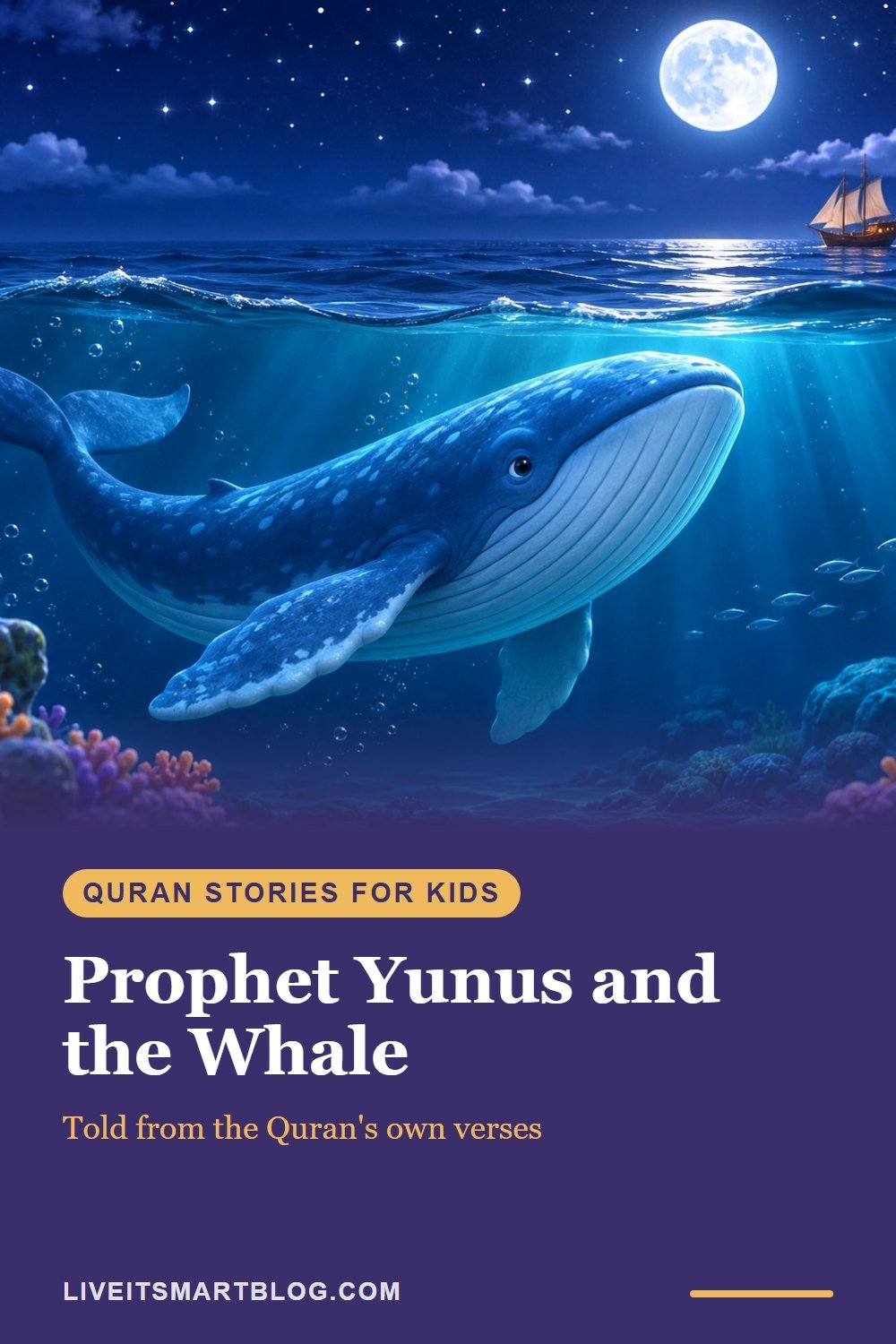
Then something no one could have imagined happened. A great fish swallowed Yunus whole.
“Then the fish swallowed him, while he was blameworthy.”
Quran, As-Saffat 37:142 (Saheeh International)
Imagine it: darkness inside the fish, darkness in the deep sea, darkness of the night. The Quran calls them “the darknesses”. Nobody could hear him. Nobody could help him. Nobody except Allah.
The dua in the darkness
Inside the fish, Yunus didn’t complain or blame anyone. He turned to Allah, praised Him and admitted his own mistake:
“…And he called out within the darknesses, ‘There is no deity except You; exalted are You. Indeed, I have been of the wrongdoers.'”
Quran, Al-Anbiya 21:87 (Saheeh International)
لَّآ إِلَٰهَ إِلَّآ أَنتَ سُبْحَٰنَكَ إِنِّى كُنتُ مِنَ ٱلظَّٰلِمِينَ
La ilaha illa anta, subhanaka, inni kuntu minaz-zalimin.
And Allah answered:
“So We responded to him and saved him from the distress. And thus do We save the believers.”
Quran, Al-Anbiya 21:88 (Saheeh International)
Look at the last words: “And thus do We save the believers.” This isn’t only Yunus’s story. It’s a promise for anyone who turns to Allah the same way.
The Quran also tells us that his remembrance of Allah is what saved him:
“And had he not been of those who exalt Allāh, He would have remained inside its belly until the Day they are resurrected.”
Quran, As-Saffat 37:143-144 (Saheeh International)
On the shore
The fish threw Yunus out onto an open, empty shore. He was weak and ill. Then Allah made a plant grow over him, a gourd vine, to shade and help him.
“But We threw him onto the open shore while he was ill. And We caused to grow over him a gourd vine.”
Quran, As-Saffat 37:145-146 (Saheeh International)
The happy ending
When Yunus was well again, Allah sent him back to his people, more than a hundred thousand of them. And this time, they believed.
“And We sent him to [his people of] a hundred thousand or more. And they believed, so We gave them enjoyment [of life] for a time.”
Quran, As-Saffat 37:147-148 (Saheeh International)
The Quran says the people of Yunus are the only town whose faith, once they believed, saved them from the punishment that was coming:
“Then has there not been a [single] city that believed so its faith benefited it except the people of Jonah? When they believed, We removed from them the punishment of disgrace in worldly life and gave them enjoyment [i.e., provision] for a time.”
Quran, Yunus 10:98 (Saheeh International)
Talk about it with your child
Start by asking what Yunus did when he was in trouble. Most children will say he prayed, and that’s right: he remembered Allah, praised Him and said sorry. Then ask whether he blamed anyone else. He didn’t. He said “I have been of the wrongdoers”, and it’s worth talking about why saying “it was my fault” takes courage.
Children also like to know when they can use his dua themselves. Any time they feel stuck, scared or sad, or when they’ve done something wrong and want to put it right. And if they ask what happened on the beach, remind them of the plant Allah grew to shade him. Allah looks after us in ways we don’t expect.
An activity to finish
Draw the story in four boxes: the full ship, the big fish in the dark sea, Yunus resting under the plant on the shore, and the happy town. In the fish box, write the dua in English or Arabic. Hang it where your child can see it at bedtime and say the dua together before sleep.
For another Quran story with a lesson for children, read the story of the owners of the orchard. There are more in our Quran stories for children, and you’ll find colouring pages and activity sheets in our free Islamic worksheets.
Want to come back to this later? Save it to your Pinterest board.

No Comments