


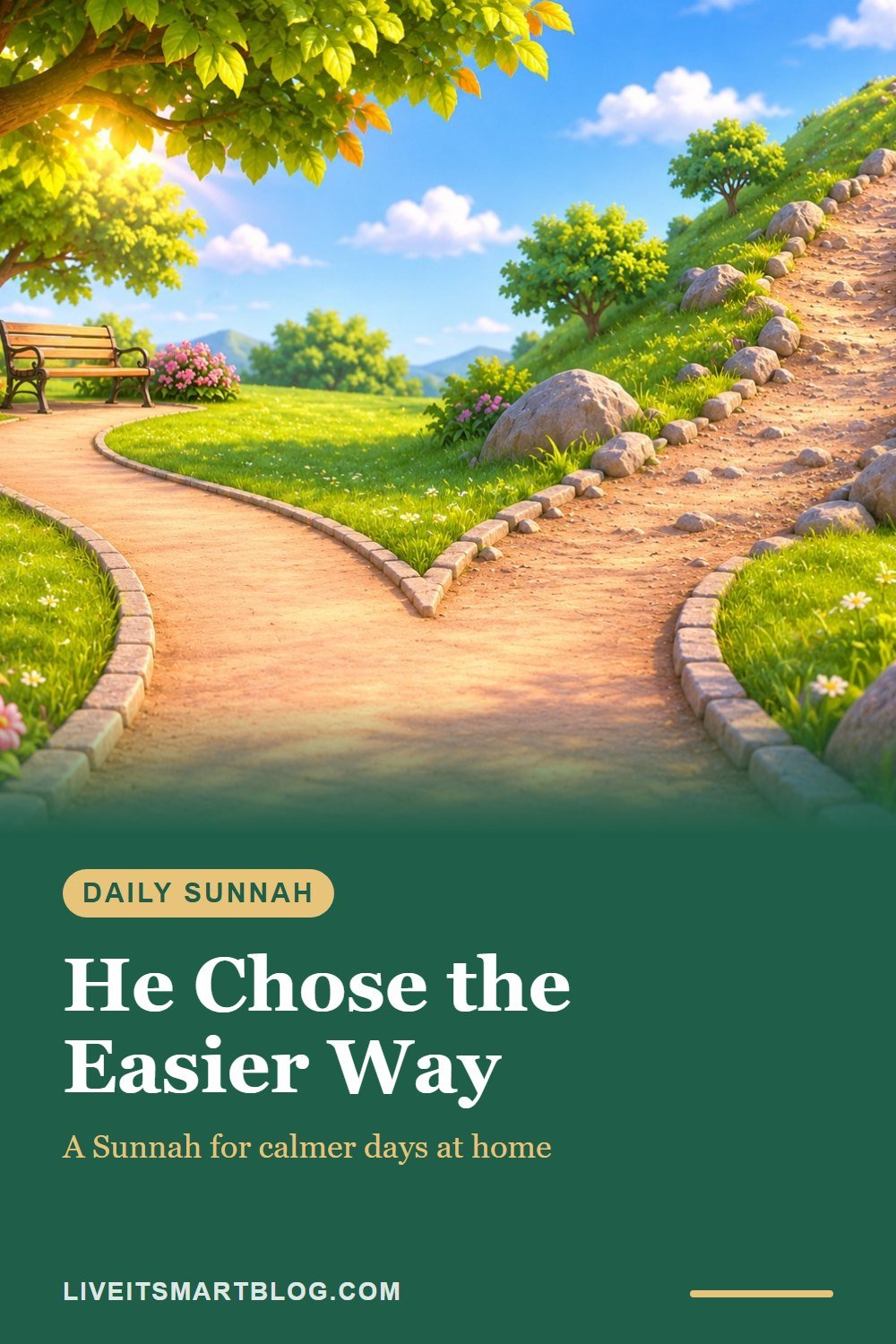
Some of us make life harder than it needs to be. We pick the longest route, the most complicated plan, the option that proves something. The Prophet Muhammad ﷺ had a different habit, and his wife Aisha described it in one sentence: he chose the easier of two things.
The easier of two things: what Aisha noticed
Aisha said that whenever the Prophet ﷺ was given a choice between two matters, he chose the easier of the two, as long as it wasn’t a sin. If it was a sin, he was the furthest of all people from it.
Sahih al-Bukhari 3560. Explained by Sheikh Mustafa Al-Adawi, who notes that this is about everyday matters.
Two conditions sit inside that sentence. The choice is between two things that are both allowed, and the easier one is chosen. When one option is wrong, ease doesn’t come into it at all.
Ease is part of the religion
This wasn’t simply his temperament. It matches what Allah tells us about the religion itself:
“…He has chosen you and has not placed upon you in the religion any difficulty…”
Quran, Al-Hajj 22:78 (Saheeh International)
“…Allāh intends for you ease and does not intend for you hardship…”
Quran, Al-Baqarah 2:185 (Saheeh International)
And when life does get hard, Allah promises it won’t stay that way:
“For indeed, with hardship [will be] ease [i.e., relief]. Indeed, with hardship [will be] ease.”
Quran, Ash-Sharh 94:5-6 (Saheeh International)
What this looks like on an ordinary day
At home, it might be dinner. If there are two ways to get it on the table and both are fine, choose the simpler one. A tired parent who serves a plain meal with a smile is following the Sunnah better than one who cooks a feast and snaps at everyone.
With children, it’s often homework. If it can be done at the kitchen table or at the desk, and the kitchen table means less arguing, pick the kitchen table. Not every battle needs to be fought.
With friends and family, it can be as small as this: when someone offers two times to meet, take the one that’s easier for both of you. When someone apologises, accept it without making them work for it.
And when it’s just you, building a new habit, like reading Quran daily or praying on time, start with the version you can actually keep. Five minutes every day beats an hour once a month.
What it doesn’t mean
This isn’t permission to cut corners on what’s right. Aisha was clear: if the easier option was a sin, the Prophet ﷺ stayed as far from it as anyone could. Ease only comes in when both choices are good ones.
Talk about it with your children
Read Aisha’s sentence to your child and ask:
Can you think of two ways to do something that are both okay? Which one is easier? Why might the Prophet ﷺ have chosen the easier one?
Then try it for a day: every time a small choice comes up, ask together, “Which one is easier, and is it okay?” Children love having a rule they can use themselves.
A lighter way to live
There’s a quiet freedom in this Sunnah. You don’t have to prove your faith by making everything difficult. Choose what’s good, and among good things, choose what’s easy. That was the Prophet’s ﷺ way.
For more of his everyday character, read The Humbleness of the Prophet Muhammad ﷺ and Your Smile Is Charity, or open Sunnah Now for a Sunnah that fits this moment of your day.
Want to come back to this later? Save it to your Pinterest board.


No Comments